
Revelation Series Resources
Welcome to our Revelation series resouces page, where you’ll find helpful information and concepts to go along with our series!

Reading Revelation
When trying to understand Revelation, we often mistakenly use only one tool: future-telling. We look at the events of our modern day, and retroactively use scripture to help make sense of it all. Sometimes it works, but more often than not, it creates fear, confusion, and hopelessness.
Every time you read Revelation, practice using these three hermeneutical tools! Hermeneutical tools are the tools and lenses through which we interpret Scripture. The better our tools, the clearer our study.

Reading Revelation with its Culture in Mind (Present)
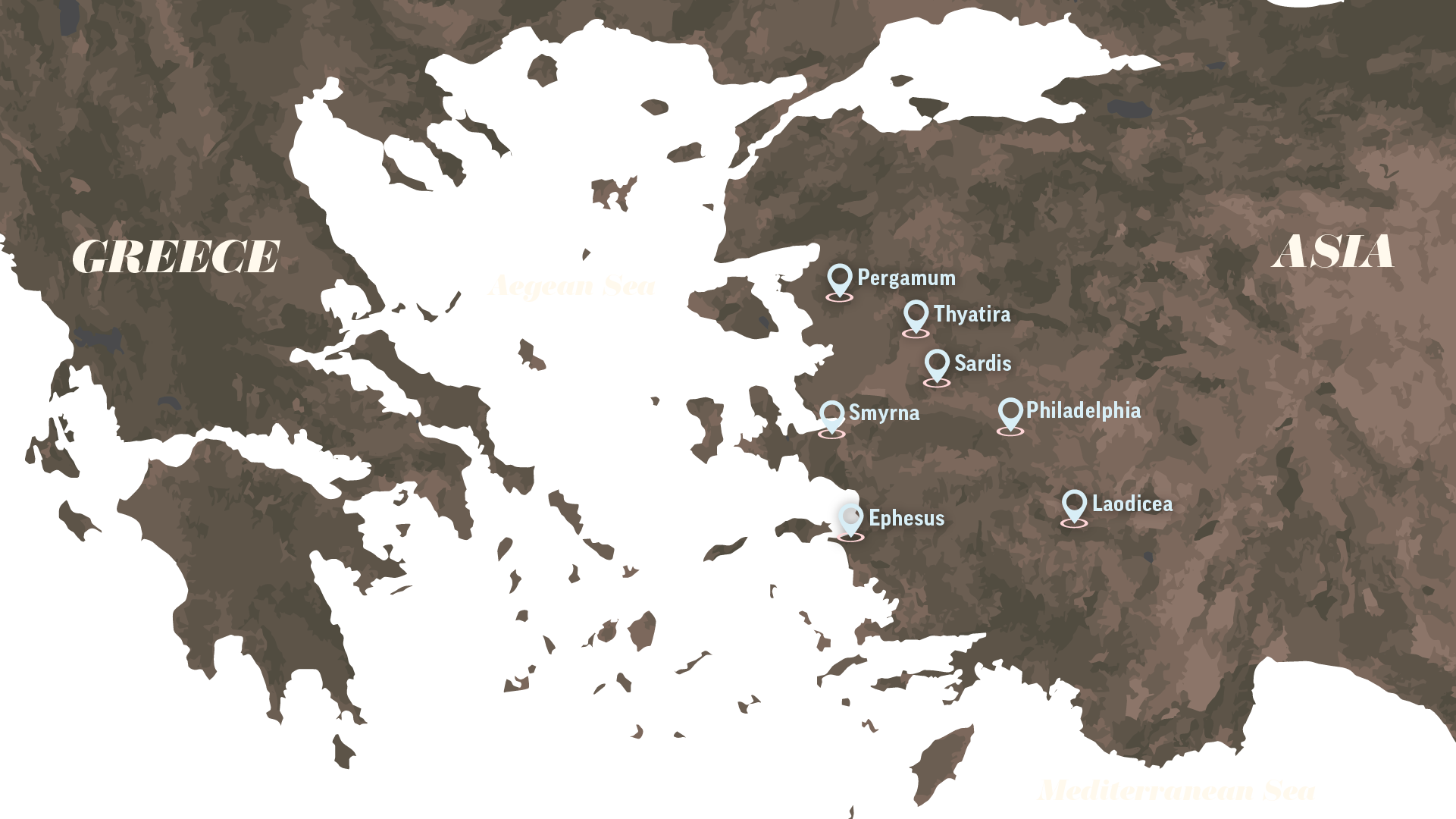
We tend to read scripture with our problems in mind, but the book has a specific audience: the churches of modern-day Turkey. To understand Revelation effectively, we need to know what questions, problems, and cultural influences they are dealing with.
Week One
Roman Civilization
Rome was a sophisticated Western culture with complicated social and political structures, and remarkable feats of war and engineering. Understanding the Roman civilization allows us to make important connections to the words of our text.
Ancient Spirituality
The ancient world ascribed to a polytheistic (many gods) view of spirituality. Each city had a god, every planet represented a god, and every activity was ordained by gods. Within this culture, John speaks a language of pagan gods that would have clearly been understood in order to offer a countercultural picture of one sovereign God.
Christian Persecution
Revelation was written during a pivotal period of world history: at the peak of Roman power and the valley of Christian oppression and persecution. The readers of Revelation find themselves scattered, attacked, and wondering if their faith is even worth it. Understanding their plight helps give clarity to the frantic and sensational imagery of the text.
Week Two
Emperor Worship
Rome occupied and controlled significant territories across the known world. One mechanism they used to maintain control was Emperor Worship. Each year, those under Roman Occupation were required to declare Caesar as Lord and burn incense in his name. Upon doing so, the priests in the Temple of Roma would provide them with a certificate stating that they had been witnessed worshipping Caesar, and by extension Rome, demonstrating your loyalty to Rome. If you did not have a certificate, you could face fines, imprisonment, or social and financial impediments.
“Synagogue of Satan”
This term is certainly rooted within the cultural vernacular of the day, and we don’t know exactly who Jesus is referring to when He calls out the Synagogue of Satan in His words to Smyrna and Philadelphia. One compelling thought is tied to the tension between Jews and Gentiles. Rome had developed a long-standing relationship with the Jewish ruling class (the Sadducees). This relationship was mutually beneficial, offering Rome peace in a historically volatile region while sparing the Jews of heavy persecution.
As a part of this partnership, Jews were exempt from Emperor worship due to their religious beliefs. This meant they did not need to worship Caesar as Lord and would not be subject to social, political, and financial persecution. However, the Sadducees declared that Gentiles were not Jews and therefore could not receive this same exemption. This had clear impacts on the Early Church, as Paul’s ministry focused heavily upon the invitation of Gentiles into the gospel message. By denying Gentiles this Jewish exemption, the Sadducees were able to bring about systemic persecution upon the early church.
Parousia and Earthquakes in Philadelphia
In the ancient world, earthquakes were commonplace, and because of ancient infrastructure, they would completely flatten cities. When this happened, the Roman Emperor would visit the city to survey the damage before giving a significant gift towards the reconstruction of the city. A few years later, they would return unannounced to see the progress. Upon their return (called Parousia), the leaders of the city would show them the work they had done and offer a token of gratitude, like a statue or building in their honor.
Philadelphia was impacted by numerous earthquakes in the first century. Each time this occurred, the emperor would help them rebuild the city. In return, the city would be renamed in honor of the emperor. This likely contributes to Jesus’ words to them about receiving a new name in Revelation 3.
Week Four
Pergamum - Revelation 2:12-13
When Jesus says to Pergamum, through John, “I know where you live”, he is saying he understands the cultural pressures they face. Pergaumum was a hub for the worship of mulitple Greco-Roman gods and goddess, with temples and buildings honoring Athena, Dionysus, Demeter, and Asclepius.
While some have fallen into the culturally convenient worship of these “gods”, others, like the martyr Antipas (verse 13), have remained faithful at great cost.

Reading Revelation with its History in Mind (Past)
Week One
Scripture
So much of the book of Revelation is rooted in texts that the ancient Jewish people would have been intimately aware of. In fact, throughout Revelation there are over 1000 references to Old Testament passages! Looking back at those texts makes clear what God, through John, is trying to communicate.
Numbers, Colors, and Symbols
If someone mentions 50 stars, 1776, Red, White and Blue, or a bald eagle, you immediately know what I am talking about! Those are numbers, colors and symbols that carry deep significance in our nation’s history. Well, the same is true in Jewish tradition. We see numbers, colors, and symbols that may seem odd, predictive, or downright crazy—but within the context of history they are obvious!
The Number 7
There are over 50 references/sets of 7 in Revelation. It’s likely that John is using the number 7 to communicate completion, wholeness, or perfection. For example, when we see the 7 churches, it could be specifically limited to those 7 churches, but it likely refers to the whole Church. When we see John reference the sevenfold Spirit of God, it could be 7 angelic visions, but it is far more likely a reference to the complete and perfect Spirit of God (The Holy Spirit).
Week Two
The Number 10
The number 10 in Jewish tradition represented an unknown, but short, period of time. This would have similarities in our culture to the phrase “a little while” or “a few days”. When Jesus talks about the persecution lasting 10 days, it is a hope-filled assurance that this persecution is temporary!
Doors + Passover
In the letter to Philadelphia in particular, we receive a lot of imagery about doors being open and shut, and final trials that are experienced or spared. These words certainly carry biblical weight as they refer to other experiences of Israelite captivity and exile. In Isaiah 45, the prophet Isaiah talks about God using a gentile ruler, King Cyrus, to free the Israelite people from their Babylonian captivity. In Exodus 12, God uses Moses to command the people to mark their doors with the blood of the lamb to spare them from the final judgment. As John writes to Philadelphia, he and his audience would likely have had these experiences in mind, framing their present struggle.
Week Six
The Scroll with Writing on Both Sides — Ezekiel 2:9-3:3
In Revelation 5, John sees God holding a scroll with writing on both sides, sealed with seven seals. This unusual description points us back to Ezekiel 2:9–10, where the prophet encounters another scroll written on both sides. That scroll contains words of mourning and woe.
The next verse in Ezekiel records John eating the scroll, but it tastes sweet as honey. We will see that image of the “honey-tasting scroll” again in Revelation 10. The point is that even though the scroll contains words of judgement, ultimately, it’s sweet because it represents God's plans for bringing judgment against evil and ultimately making things right.
The Scroll with Seven Seals
The seven seals are also significant. Throughout Revelation, the number seven represents completeness or fullness. A scroll sealed seven times is completely sealed. No one can open it unless they are worthy.
The Sealed Scroll of Daniel — Daniel 12:4, 9
The imagery of a sealed scroll also takes us back to Daniel 12. Daniel receives a vision concerning the end of suffering, the resurrection of the dead, and God's ultimate victory. But he is instructed to seal up the words until the time of the end.
Centuries later, John encounters another sealed scroll. The connection is compelling: what Daniel was told to seal up is now ready to be revealed.
This helps explain why John weeps when no one is found worthy to open the scroll. If God's plans cannot be carried out, what hope is there for the final defeat of evil, suffering, and death?
But Revelation 5 doesn't end with John's tears. Someone has been found worthy.
The Lion of Judah — Revelation 5:5 and Genesis 49:8–10
When John begins to weep, one of the elders tells him to look at the Lion of the tribe of Judah.
This title comes from Genesis 49, where Jacob blesses his son Judah and describes him as a lion. He also promises that royal authority will belong to Judah and that the nations will obey him.
This became an important expectation for Israel: a future king would come from Judah's descendants.
The Root of David — Revelation 5:5 and Isaiah 11
Revelation also calls Jesus the Root of David, drawing our attention to Isaiah 11.
Interestingly, one of the main expectations people had in Israel’s day of what the Messiah would do is 1) restore Israel, 2) Re-unify Israel with Judah, and 3) win victory over all the other nations.
Israel was split into the northern Israel and the southern Judah after King Rehoboam’s decisions led to civil war. Assyria later conquered Israel, scattering its people; some joined Judah, while others remained and became the Samaritans. Judah eventually fell to Babylon but continued after the exile. After the exile, the returning Judahites adopted the name Israel, even though they were the remnant of Judah.
What’s the point of all that history? Because Isaiah 11 seems to promise that one day Israel will be back, be reunited with Judah, and even the gentile nations will join in with them as well in great kingdom of extreme peace as they all rally to one banner: the Messiah who is descendent of David. That chapter in Isaiah also contains one of the Bible's most recognizable pictures of future peace: the wolf living with the lamb. The point is it will be a future time of lasting and extreme peace where even a wolf and lamb could sleep next to each other without fear.
Jesus does some of that in his first coming (creating a kingdom for everyone, not just Israel). But not all of it. That’s one of the reasons so many Jews in Jesus’ day didn’t believe he was the Messiah. He never seemed to completely fulfill that prophecy from Isaiah. Revelation tries to answer that question by continually reminding us that God hasn’t forgotten. Keep a look out
Seven Eyes and the Seven Spirits — Revelation 5:6
The Lamb also has seven eyes, which John identifies as the seven spirits of God sent throughout the earth.
The first layer of this image is a little easier. Seven means complete or fullness. So seven spirits of God means full spirit of God, aka The Holy Spirit. The idea being that, in a sense, the Holy Spirit comes from God the Father and God the Son to be God’s eyes and ears throughout the world today. For any complete theology nerds, feel free to google the Greek word filioque. That word stands at the center of what originally divided the Eastern Orthodox and Catholic churches in A.D. 1064, and this verse and image stood at the center of that debate as they argued over whether the Holy Spirit comes from God the Father alone, or God the Father and God the Son.
To peel back the second layer of this image, we must turn to Zechariah 3–6.
In Zechariah 3:9, God describes a stone placed before Joshua the high priest (not a symbol, Joshua was the name of the literal high priest of Israel at the time) that has seven eyes. Then, in Zechariah 4:10, the seven eyes are identified with the eyes of the LORD that range throughout the earth.
Zechariah 4:6 also contains God's famous declaration: "Not by might nor by power, but by my Spirit."
These connections help explain the imagery in Revelation 5. The seven eyes represent the complete and perfect Spirit of God, sent throughout the earth. John likely is not describing a literal seven-eyed sheep. He's using Old Testament imagery to communicate something about Jesus and the Holy Spirit.
Interestingly, a lot of other Revelation imagery comes from this section of Zechariah as well.
In Zechariah 4, the prophet sees a golden lampstand with seven lamps. In Revelation 1, John sees seven golden lampstands representing the seven churches.
Zechariah 6 describes four chariots with differently colored horses, sent out from the presence of the Lord. This imagery provides an important Old Testament background for the famous Four Horsemen introduced in Revelation 6.
Zechariah also describes Joshua the high priest as symbolic of something to come (the Messiah). Then it expands on that by saying the Messiah is called the Branch (read Root of David described above) and that this figure will be Joshua the High Priest but also dawn the crown of Zedekiah (king of Judah at the time). Meaning the imagery of priesthood and kingship comes together.
One particularly interesting detail is Joshua's name. In Hebrew, Joshua is pronounced Yeshua. If you pronounce Yeshua through Greek and then Latin, you get Jesus. Meaning, linguistically, Joshua and Jesus are the same exact name. Some Christians have understood Zechariah’s words as a direct prophecy that our saviors name would be Jesus written down 500 years before his birth.
A Kingdom of Priests — Revelation 5:9–10 and Exodus 19:6
In Revelation 5:10, John tells us that Jesus has made those He redeemed into a kingdom of priests who will reign on the earth. This is a direct connection to Exodus 19:6, where God tells Israel that they are to be a "kingdom of priests and a holy nation."
In the Old Testament, priests served as representatives between God and His people. But God's plan was always bigger than Israel alone. Through Jesus, people from every tribe, language, and nation are brought into God's kingdom and given the privilege of serving Him.
This is also echoed in 1 Peter 2:9, where believers are called a "royal priesthood," and Revelation 1:6, which says Jesus has made us a kingdom and priests to serve God.
The point is that Jesus didn't simply save us from something. He saved us for something: to belong to His kingdom, serve Him, and share in His coming reign.

Reading Revelation with Timeless Truth in Mind (Future)
Apocalyptic Prophecy
Apocalyptic Prophecy is not intended to provide a crystal ball that predicts the future. Instead, it is a heavenly perspective on the events of our humanity that is rooted in the certain victory of God. As such, it offers timeless truths that resonate in every time, culture, and circumstance. The question then is not “Who is the antichrist?” but instead “Who is working now against the way of Christ”?
In this way, Revelation offers us a profound invitation to action in the here and now—rather than a passive prediction of waiting for something still to come.
Timeless Truths in Revelation
Week One
No matter how bleak or difficult life may get. The one true God is present with us through His Church, and He and only He holds the universe in His hand!
Week Two
Smyrna - Revelation 2:8-11
Culture invites us to subtle compromises with compounding consequences.
Philadelphia - Revelation 3:7-13
Earthly empires promise just enough to keep us coming back, but never enough to satisfy.
The Kingdom of Heaven promises that the love of Jesus is enough—and He is coming back to us.
Week Three
Over time a “New Faith” will become a “Normative Faith.” If we are not attentive it can quickly become a “Neglected Faith.” A “Neglected Faith” will inevitably lead us to becoming stuck!
Ephesus - Revelation 2:1-6
Community is not simply a social mechanism that cures loneliness, it is the earthly dwelling place of the presence of God.
STUCK IN YOUR FAITH? ASK THIS: Where am I actively and regularly experiencing the presence of God through the love of community?
Sardis - Revelation 3:1-3
STUCK IN YOUR FAITH? ASK THIS: Where do I take the most pride in my faith journey, and what might that pride be blinding me to?
Laodicea - Revelation 3:14-16
STUCK IN YOUR FAITH? ASK THIS: Is my faith bringing purpose into every piece of my life, or is it just another piece of my life?
Week Six
God's Promises Haven't Failed — Revelation 5:1–6
Throughout the Bible, God promises a future without evil, suffering, and death. But for Christians experiencing persecution, grief, and unanswered prayers, those promises can sometimes feel distant.
The first readers of Revelation knew that feeling. They believed Jesus was King, but earthly kings were still persecuting them. They believed Christ had conquered death, but their friends and families were still dying.
Revelation 5 reminds us that God's promises haven't been forgotten.
Jesus has already won the victory, and the day is coming when He will bring that victory to its complete fulfillment.
Our present suffering isn't proof that God has failed. It's a reminder that the story isn't finished.
The Prayers of God's People — Revelation 5:8
When the Lamb takes the scroll, the living creatures and elders fall before Him holding golden bowls filled with incense.
John tells us exactly what the incense represents: the prayers of God's people.
Think about what that means. The prayers of believers are pictured in the throne room of heaven, before God Himself. Even when our prayers seem unanswered, they haven't been forgotten. God hears the cries of His people, and His plans for justice and restoration are moving toward their fulfillment.
A Future Worth Longing For — Revelation 5:11–14
We often approach Revelation with fear and confusion. The unusual creatures, symbols, and judgments can make it an intimidating book. But Revelation was written to give hope to God's people.
In chapter 5, John sees a future where the Lamb receives the praise of heaven and earth. The redeemed come from every tribe, language, people, and nation.
People who once belonged to nations divided by hatred and war will worship the same Savior together. The divisions that characterize our present world will not have the final word. Jesus will.
Reading Revelation with Revelation in Mind (The 7 Churches)
Week Five
THRONES
Revelation 3:21 – Letter to Laodicea
“To the one who is victorious, I will give the right to sit with me on my throne, just as I was victorious and sat down with my Father on his throne. Whoever has ears, let them hear what the Spirit says to the churches.”
WHITE ROBES
Revelation 3:4 – Letter to Sardis
“Yet you have a few people in Sardis who have not soiled their clothes. They will walk with me, dressed in white, for they are worthy.”
Revelation 3:18 – Letter to Laodicea
“I counsel you to buy from me gold refined in the fire, so you can become rich; and white clothes to wear, so you can cover your shameful nakedness; and salve to put on your eyes, so you can see.”
CROWNS
Revelation 3:11 – Letter to Philadelphia
“I am coming soon. Hold on to what you have, so that no one will take your crown.”
Revelation 2:10 – Letter to Smyrna
“Do not be afraid of what you are about to suffer. I tell you, the devil will put some of you in prison to test you, and you will suffer persecution for ten days. Be faithful, even to the point of death, and I will give you life as your victor’s crown.”
Week Six
Seven Horns — Revelation 5:6 and Revelation 13
When John looks for the Lion, he sees a Lamb who appears to have been slain. This Lamb has seven horns. We see horns associated with kings and kingdoms elsewhere in Scripture, including Daniel and perhaps most importantly in Revelation 13.
Remember that seven represents completeness or fullness.
By describing Jesus as a Lamb with seven horns, John is communicating His complete power and authority. Although He appears to have been slain, He is no defeated victim. He is the victorious King.
Reading Revelation with Jesus in Mind
Week Six
Revelation contains some of the Bible's most complicated imagery. But one of the most important questions we can ask when reading it is surprisingly simple: What is this passage telling me about Jesus?
We should also ask how the Gospel—Jesus' life, death, and resurrection—helps us understand what we're reading. Revelation isn't simply a book about future events. It is a revelation of Jesus Christ.
Why Is the Lamb Worthy? — Revelation 5:7–10
When Jesus takes the scroll, heaven erupts in worship. But why is He worthy to open it?
The answer comes in verse 9:
"Because you were slain, and with your blood you purchased for God persons from every tribe and language and people and nation."
Jesus is worthy to open the scroll because He gave His life to redeem us.
The Lamb who appears to have been defeated is actually the victorious King. His sacrifice is the very reason He is worthy to carry out God's plans.
This is the heart of Revelation 5: the victory of Jesus and the extraordinary love of God demonstrated through His sacrifice.
Worthy Is the Lamb — Revelation 5:11–14
The chapter concludes with an extraordinary picture of worship.
Thousands upon thousands of angels praise the Lamb, declaring that He is worthy to receive 1) power, 2) wealth, 3) wisdom, 4) strength, 5) honor, 6) glory, and 7) praise.
Did you catch that number? Seven. Seven expressions of praise communicate His complete worthiness. Jesus is worthy of all worship and praise.

Revelation Resources
Check here for various resources: videos, audios, podcasts, books, and more! This section will be updated as our series goes on!
1. The Bible Project Video on Revelation-week 1 (Click Here)
2. Book: Revelation For the Rest of Us: A Prophetic Call to Follow Jesus as a Dissident Disciple, by Scot McKnight (Click Here)
3. BEMA Podcast, episodes 174-189 (Click Here)
4. That The World May Know video, Ray Vander Laan (Click Here to Purchase)
5. The Bible Project Video on Angels-week 5 (Click Here)
6.Book: Reversed Thunder, by Eugene Peterson - week 7 (Click Here)